
What We Believe
Read our manifesto ↓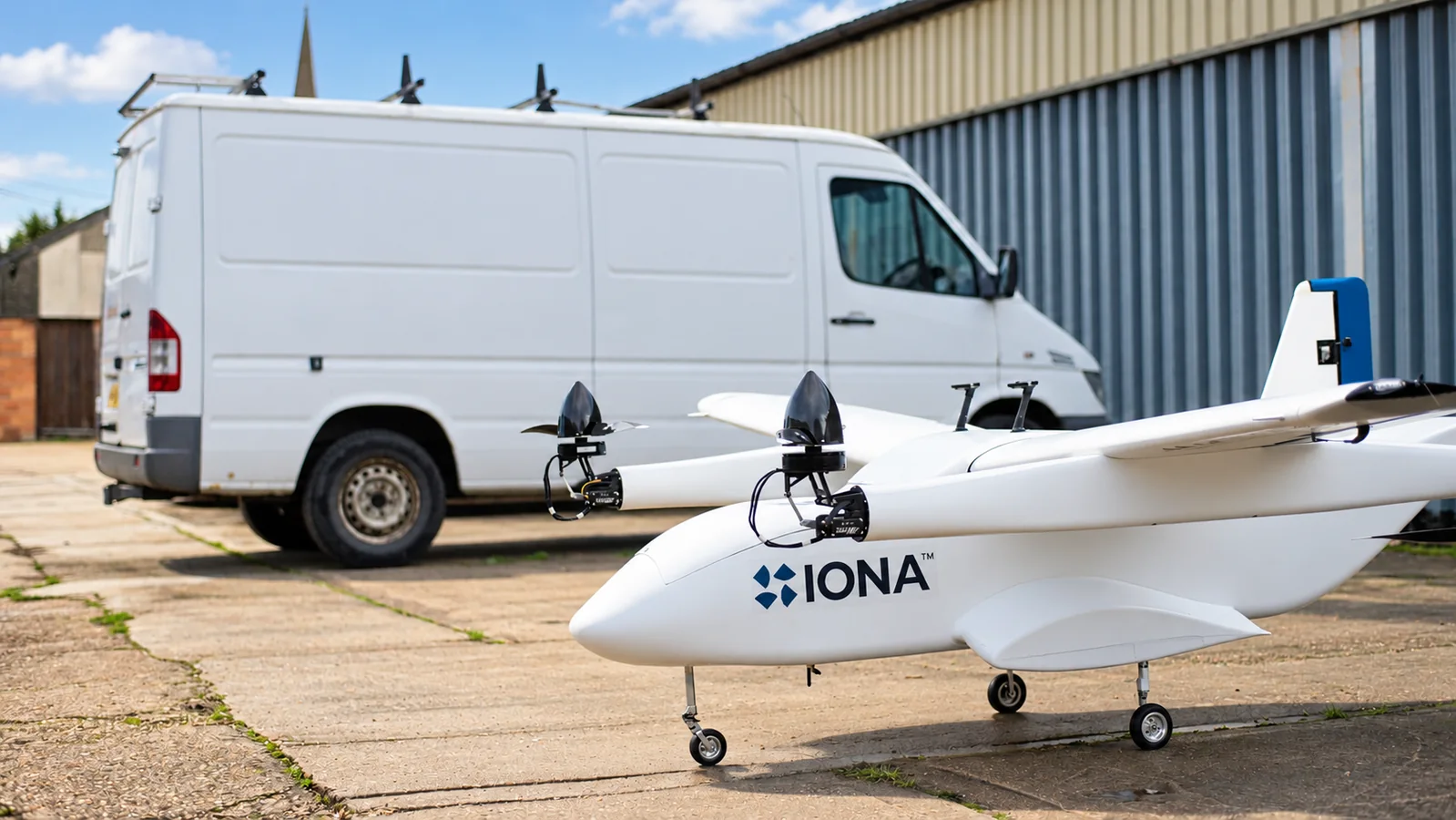
Roads are Roman technology.
Three thousand years ago, the Roman Empire connected its world by building roads. Stone, gravel, labour, and time – laid down mile by mile so that goods, soldiers, and messages could move from one place to another faster and more reliably than ever before.
We are still using that infrastructure.
The vehicles changed. The fuel changed. The speed changed. But the fundamental constraint did not: if there is no road, there is no delivery. If the road is long, the delivery is slow. If the route is unprofitable, the delivery never happens.
Roads gave us the world we have. They also defined its limits. More than 30% of the population lives in places where a simple delivery costs 3 to 10 times more than in urban centres – not because the demand is missing, but because the road is. People leave. Businesses close. Communities shrink. The map of economic opportunity is still drawn by where the Romans would have built.
Two shifts already happened. The third is starting.
The internet made information weightless. Any message, any data, any idea – from any device to any other device, instantly, at near-zero cost. Optic fibre for dense areas and Starlink for remote locations or special services. Industries, cities, and entire economies reorganised around the fact that information no longer needed to travel physically.
Solar, batteries, and heat pumps did the same for energy. Generation moved from centralised plants to distributed networks. A village in sub-Saharan Africa now produces the same clean electricity as a city in Northern Europe. Energy stopped being something you piped from far away and became something you generated where you stood.
Physical goods have not had their moment yet.
Moving a parcel still requires a vehicle, a driver, a road, and a tight schedule. The system works in dense areas – barely. Outside them, it fails. And unlike information and energy, nobody has built the infrastructure that changes this.
IONA is building it.
The physical internet
We use this term deliberately.
The internet did not improve the postal service. It replaced the need for physical movement of information entirely. Solar did not make coal plants more efficient. It made a fundamentally different architecture possible.
The physical internet is not faster vans or better route planning. It is a new architecture for moving goods – autonomous networks that connect people, businesses, and communities to what they need, without depending on roads, drivers, or schedules.
Today, a logistics operator who wants to serve a new route must acquire vehicles, hire drivers, and negotiate with local authorities. Each new route is a capital investment with uncertain return. The economics favour density. Rural and remote areas are structurally underserved – not temporarily, but permanently, because the underlying infrastructure cannot reach them profitably.
With IONA, customers can discuss a delivery route without setting up an aircraft operation of their own. We assess the route, agree the service and handle the operation. Our ambition is to make more communities reachable through practical package deliveries.
The world changes shape.
What IONA is
IONA is a delivery service. Customers pay us to take their packages from A to B. We use drones to make those journeys, and our team manages the operation from planning to handover.
We develop and operate the aircraft, software and ground infrastructure behind that service. The purpose is straightforward: connect people and businesses with the goods they need, including places where road delivery is difficult.
For logistics partners, IONA carries out deliveries on their behalf. They keep their brand and customer relationships while we take responsibility for the drone operation. Customers buy a delivery service; they do not need to buy aircraft or run a flight operation.
Three beliefs
The hardest delivery is the most valuable. Remote communities, island populations, rural healthcare networks – these are the routes that traditional logistics cannot serve profitably. They are also where willingness to pay is highest, social impact is greatest, and the competitive landscape is emptiest. We start where the problem is sharpest. We expand from there.
Regulation is infrastructure, not a barrier. Most companies in this space treat regulatory approval as the final hurdle. We treat it as the foundation. Our system is compliant by design – built with the people who wrote the rules. Each new route inherits the framework. This is what makes scaling fast, and what capital alone cannot replicate.
Energy efficiency is the moat. The marginal cost of every delivery converges on the marginal cost of the energy. The aircraft that moves the most cargo on the least energy wins – permanently, and more decisively at scale. Drones fly point to point: no roads, no terrain penalties, no density requirements. For the routes that matter most, the physics favours flight over ground by an order of magnitude.
The stakes
This is not a marginal improvement to logistics. It is a new category of infrastructure – as fundamental as roads were to the Romans, as the internet was to information, as distributed energy was to power.
When roads no longer limit delivery access, new possibilities emerge. Communities that were shrinking reconnect to commerce. Healthcare reaches patients who were hours from a hospital. Businesses operate where geography used to forbid it. Supply chains stop being hostage to road networks and driver shortages.
IONA is building this. Not as a vision statement. The first routes are already in the air.
IONA Logistics Ltd. - April 2026